


Why targeting VPNs in the name of child safety risks weakening privacy, security and common sense across the UK internet.
Last month, peers in the House of Lords backed an amendment linked to the Children’s Wellbeing and Schools Bill that would, if it survived the next stages, push the UK towards prohibiting VPN services for children under 18. The stated aim is to stop young people using VPNs to bypass age verification linked to the Online Safety Act.
On paper, that may sound neat. In practice, it is clumsy, hard to enforce, and likely to create bigger problems than it claims to solve.
VPNs are a normal part of modern internet use. They are used by households, remote workers, journalists, travellers, small businesses, and plenty of ordinary people who simply prefer not to have their online activity profiled. Any serious proposal to restrict them needs to be grounded in how the internet works, how teenagers behave online, and what unintended consequences will land on everyone else.
Why a VPN Ban for Children Is a Blunt Tool
The argument driving this amendment is that some children use VPNs to evade age gates. Even if you accept that as a genuine concern, a VPN ban still does not deliver what its supporters think it will.
First, the internet is not a single controlled system. Children who actively seek to bypass restrictions rarely stop because one method becomes inconvenient. They switch methods. That is not cynicism, it is basic reality. As the debate around this amendment itself acknowledges, people can create their own VPNs, use proxies, remote desktop tools, or find services that do not enforce the same checks. Regulation aimed at a specific tool often becomes a game of whack a mole.
Second, blanket restrictions tend to steer users towards worse outcomes. If reputable VPN providers are pushed into burdensome age checks, it creates room for risky operators to fill the gap. That is not a theoretical risk, it is a pattern seen repeatedly online. Users who want privacy will still seek privacy, and they may end up with services that have poor security, weak standards, or questionable data practices.
Third, VPNs are not niche. They are built into how many people work and stay safe online. The source content makes this point plainly, VPNs can be “deeply integrated into modern protection and network optimisation systems, often acting seamlessly in the background”. A policy that treats VPNs as an optional add on misunderstands how widely they are used.


Age Verification, Privacy, and Adult Consequences
The conversation around children and age gates often skips over the real tension, adults do not want to hand personal or financial details to unknown third parties simply to browse the open web.
Age verification is contentious because it can spread beyond the narrow category many people assume it targets. The Online Safety Act and Ofcom’s approach can touch a wide range of sites and services, large and small, and not all of them are obviously adult. When age checks become normalised, the pressure grows to apply them more broadly, and the privacy risks multiply.
The source content highlights a reason many adults are uneasy, “Many adults do not want to have to share their private personal or financial details with unknown and unregulated third-party age verification providers”. That concern is not fringe. It is a common reaction to the idea of centralising sensitive data in the hands of multiple intermediaries, each with their own security posture, incentives, and potential for failure.
This is also why the idea of banning VPNs for children has wider implications. To enforce age restrictions on VPN access, providers would be nudged towards collecting more information about users. That is the opposite direction to travel if the aim is safety and privacy.
Lord Knight of Weymouth put the issue succinctly, “VPNs can make us more secure, and we should not rush to deprive children of that safety”. That is the heart of it. The internet is not safer when you remove security tools. It is simply less protected.
Unintended Consequences for Schools, Families, and Security
Even if the amendment is aimed at consumer VPN use, the fallout does not stay neatly contained.
Schools and colleges often use VPNs for remote access and safeguarding controls. Families use VPNs for privacy on public WiFi, for travel, and for secure access to services. Many devices now connect in the background, without a user consciously pressing a button. Trying to police VPN usage based on age introduces confusion and inconsistency, especially in shared households where devices, accounts, and networks overlap.
There is also a social reality that is easy to miss in Westminster. Young people use the internet for far more than doomscrolling. They collaborate, learn, create, and organise. They also consume news. Lord Knight highlighted that young people are often well informed through online platforms and asked whether it makes sense to expand participation in civic life while restricting access to information. That question matters because online safety policies have a habit of drifting from targeted protection into general restriction.
The deeper issue is that policy makers often reach for the most visible lever rather than the most effective solution. Age gates that rely on broad internet controls sound decisive. They are also a magnet for edge cases, loopholes, and collateral damage.
If the genuine aim is child safety, there are more sensible approaches. Better device level controls, better parental tools, clearer platform accountability, and better education about online risk are all more targeted than trying to restrict a widely used security technology.

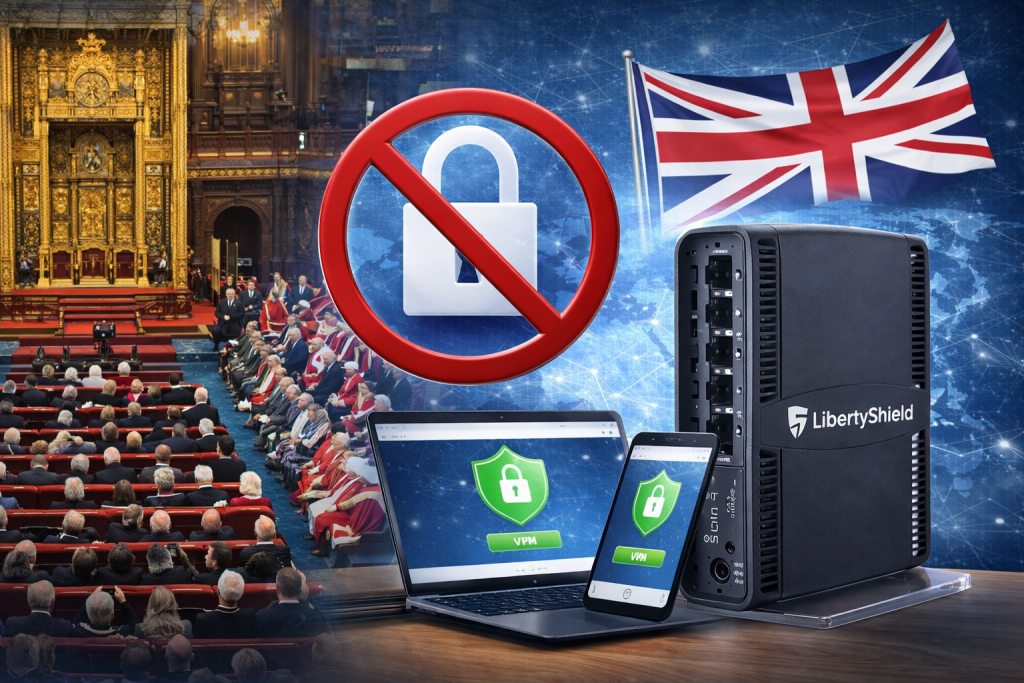
Where LibertyShield Stands on This
As a UK based VPN provider, we understand why protecting children online matters. We also believe proposals like this are misguided.
VPNs are a privacy and security tool. They are used legitimately every day by ordinary people, including families and travellers. Banning or age gating VPNs does not address the underlying problem of harmful content and platform design. It mainly creates new risks, encourages workarounds, and undermines privacy for people who have done nothing wrong.
At LibertyShield, we have built our service around practical, everyday use, whether that is through our VPN routers, software, or apps. Many of our customers are families abroad, expats, and people who want a secure connection when travelling or using public networks. We also keep zero logs of user website activity, app usage, and browsing history on our network, because privacy should not be a marketing slogan; it should be built in.
If the UK wants a safer internet, it should focus on smart, enforceable measures that do not weaken security tools for everyone else. A sledgehammer approach aimed at VPNs will not stop determined teenagers, but it will create headaches for schools, families, and anyone who values privacy online.